Hiring a full-stack developer is one of the most consequential decisions you will make as a technical leader. Get it right, and you gain an engineer who can ship features end to end. Get it wrong, and you lose months to ramp-up, rework, and a second search.
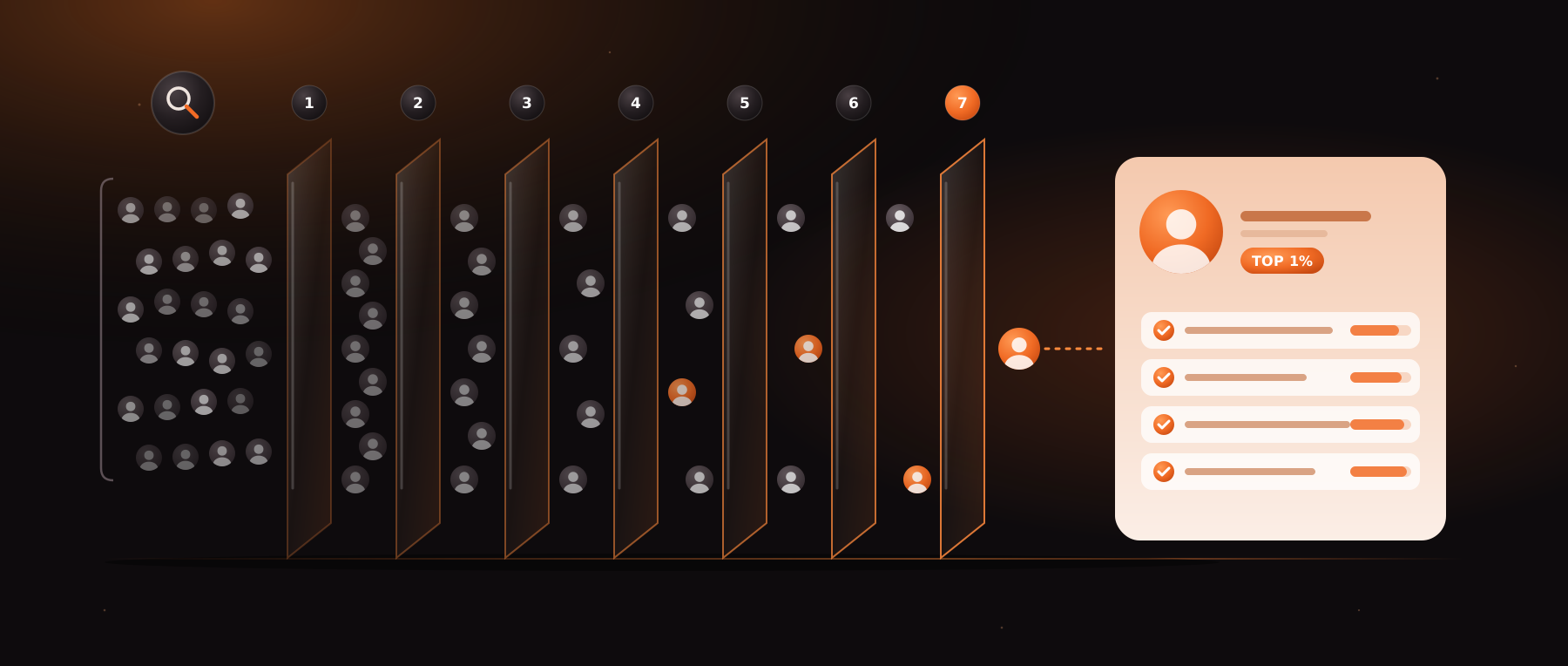
This guide gives you a structured, 7-step screening framework for evaluating full-stack developers in 2026. Each step is designed so you can move quickly without lowering the quality bar your team depends on.
Smart Working uses a multi-stage vetting process to identify the top 1% of engineering talent globally, and the principles behind that process inform every step below.
How to vet full-stack developers quickly and thoroughly
1. Define the role around delivery needs
Start by listing the features and systems your team needs to deliver in the next 90 days. A clear delivery plan tells you which front-end frameworks, back-end languages, and infrastructure tools the role actually requires.
Avoid writing a generic "full-stack developer" job description that lists every technology your company has ever used. Instead, specify two or three primary technologies (for example, React on the front end and Node.js on the back end) and mark everything else as a secondary skill.
Document deployment expectations too. If your team uses Docker and Kubernetes for CI/CD, the candidate needs to be comfortable in that pipeline from day one. This specificity reduces time spent evaluating candidates who do not match your actual needs.
2. Check for depth on both front end and back end
A credible full-stack developer can go deep on at least two layers: the front-end UI layer and the back-end application layer. During an initial technical screen, ask candidates to walk through a complex component they built on the front end and a service or API they designed on the back end.
Probe for trade-off reasoning. If a candidate chose PostgreSQL over a NoSQL database, ask them to explain the constraints that drove that decision. Engineers who think in trade-offs demonstrate the kind of depth that shows they can handle production-level decisions, not just tutorial-level exercises.
Pay attention to how they describe database indexing, query optimisation, and caching strategies. These are the areas where many generalists lose depth, and where production reliability is won or lost.
3. Review recent product work, not just portfolios
Polished portfolio sites can be misleading. A more reliable signal is the code a candidate has shipped to production in the last 6 to 12 months. Ask for a link to a recent pull request, a deployed feature, or a public repository where commit history is visible.
Look at how the candidate structures code directories, handles error states, and writes tests. These details reveal habits that interviews alone cannot surface. Open-source contributions and technical writing are additional signals of a candidate who invests in their craft beyond what a job requires.
When reviewing, focus on how well the code would survive a team handoff. Code that is clean and well-documented tends to come from engineers who think about long-term maintainability, not just short-term delivery.
4. Run a structured technical assessment
Replace unstructured whiteboard interviews with a timed, proctored assessment that mirrors real problems from your codebase. The assessment should cover at least three dimensions: front-end component construction, back-end API design, and basic system architecture.
Use a standardised rubric so every evaluator scores the same dimensions. This eliminates gut-feel decisions and gives you comparable data across candidates. Smart Working's own 4-stage vetting process applies timed, proctored assessments where candidates must demonstrate internalised knowledge rather than information retrieved in real time.
Keep the assessment under 90 minutes. Longer exercises increase candidate drop-off without improving your signal quality. A focused 60 to 90 minute test tells you more about applied skill than a 6-hour take-home project ever will.
5. Test communication in real working scenarios
Technical skill alone is not enough. A full-stack developer who cannot explain a technical decision to a product manager or contribute constructively in a code review will create friction across your team.
Set up a live scenario where the candidate joins a simulated sprint planning session or walks through a pull request review with a member of your engineering team. Observe how they ask clarifying questions, handle conflicting requirements, and explain technical constraints in plain language.
Async communication matters just as much. Ask the candidate to write a brief summary of a technical decision, similar to what they would post in Slack or a design document. This step is especially important if your team includes remote or distributed engineering talent working across multiple time zones.
6. Validate speed, ownership, and reliability signals
Delivery velocity separates a strong full-stack developer from an average one. During reference checks or the interview itself, ask for concrete examples of deadlines met, production incidents resolved, and features shipped without waiting for someone else to unblock progress.
Look for ownership signals. Did they identify and fix a performance bottleneck without being asked? Did they set up monitoring or alerting on a system they built? Engineers who take end-to-end ownership of what they ship tend to stay accountable well beyond the initial build.
Also ask about test coverage discipline and CI/CD habits. A developer who routinely writes automated tests and deploys through a structured pipeline is far less likely to introduce regressions into your production environment.
7. Build a low-risk final decision process
Structure your final evaluation so you can hire with confidence without creating unnecessary exposure. A paid trial period of one to two weeks gives both sides a chance to confirm the working relationship before committing long-term.
During the trial, set specific deliverables the candidate should complete using your actual tools, repositories, and communication channels. Evaluate not just the output but how the person collaborates with your existing team, asks for context, and adapts to your workflow.
If a trial is not feasible, use a structured scorecard that aggregates data from every previous step. Require sign-off from at least two independent evaluators before making an offer. This minimises the risk of a single interviewer's bias driving the decision.
What should you test in a full-stack developer interview?
A full-stack developer interview should test four core areas: front-end proficiency, back-end design, database knowledge, and system-level thinking. Covering all four gives you a complete picture of whether the candidate can own a feature from the user interface down to the data layer.
For front-end assessment, focus on component architecture, state management, and responsive design patterns. On the back end, evaluate API design, authentication flows, and error-handling strategies. Database questions should cover indexing, query optimisation, and the trade-offs between relational and document-based storage.
System design questions round out the picture. Ask the candidate to sketch the architecture for a feature your team is actually planning. This tests whether they can think beyond individual functions to the broader system, including deployment, scaling, and observability. According to the EngRadar Full-Stack Hiring Report for July 2026, employers are heavily skewing toward senior and principal-level hires, making system-level competence a non-negotiable screening criterion.
How fast can you vet full-stack developers without cutting corners?
A rigorous vetting process does not have to take months. With a structured framework, you can move from first screen to final decision in 10 to 14 business days while still covering every essential evaluation dimension.
1. The key is parallel processing. Run the technical assessment and the communication evaluation in the same week. Schedule reference checks while the candidate completes a brief trial task. Each step feeds into a centralised scorecard, so the final decision is based on aggregate data rather than a single interview impression.
2. Smart Working compresses time-to-hire to an average of 10 days by front-loading the process with AI-assisted screening, timed technical assessments, and dual-evaluator live interviews. Your internal process can follow the same principle. Invest in upfront structure so each stage produces a clear, actionable signal without requiring a second round.
How Smart Working helps you vet full-stack developers faster
Smart Working provides access to pre-vetted full-stack developers who have already cleared a 4-stage assessment covering technical skill, logical reasoning, communication proficiency, and background verification. Only the top 1% of applicants reach a client interview.
Each dedicated developer is matched to your specific tech stack and delivery needs through a calibrated scoping process run by a UK-based team. You receive an elite shortlist within 5 days and can onboard your chosen engineer within 10 days.
You also get a dedicated Customer Success Manager who monitors performance, manages HR and payroll, and supports long-term retention. With a 96% developer retention rate and 40 to 50% annual cost savings compared to local hiring, Smart Working is built so you can scale your engineering capacity without the overhead and risk of traditional recruitment.
Ready to scale your engineering team? Book a call to receive your vetted shortlist in less than a week. No placement fee, no minimum contract.